tax
Optional Standard Deduction (OSD) vs. Itemized Deductions: Which One Saves You More Tax?
Posted by Mariel Therese Deocampo
onAugust 03, 2026
When filing your income tax return in the Philippines, one key decision can directly impact how much tax you’ll pay: choosing between Itemized Deductions and the Optional Standard Deduction (OSD).
Each method offers different benefits, documentation requirements, and savings potential — depending on your business model and expense structure. Understanding how these deductions work under current BIR regulations empowers you to file smarter and reduce tax liabilities legally.
What Are Itemized Deductions?
Itemized deductions refer to your actual business expenses for the year that are necessary and directly related to earning income.
Eligible expenses include:
Rent and utilities
Employee wages or contractor fees
Office supplies and equipment
Marketing, software subscriptions, and professional services
Transportation and depreciation
These costs must be supported by valid invoices, in compliance with the BIR's substantiation rules and standard bookkeeping requirements.
If your actual allowable expenses are higher than 40% of your gross sales or gross receipts (for individual taxpayers) or 40% of your gross income (for non-individual taxpayers), you may pay less income tax by claiming itemized deductions instead of the Optional Standard Deduction (OSD).
What Is the Optional Standard Deduction (OSD)?
The Optional Standard Deduction allows eligible taxpayers to claim a fixed deduction instead of listing every actual expense.
For individual taxpayers, such as self-employed individuals, professionals, and sole proprietors, the Optional Standard Deduction (OSD) is 40% of gross sales. For non-individual taxpayers, including corporations, the OSD is 40% of gross income.
Example for an individual taxpayer:
Gross receipts: PHP 1,000,000
OSD: 40% × PHP 1,000,000 = PHP 400,000
Taxable income after OSD = PHP 600,000
Example for a non-individual taxpayer:
Gross receipts: PHP 1,000,000
Cost of Sales: PHP 400,000
Gross Income: PHP 600,000
OSD: 40% × PHP 600,000 = PHP 240,000
Taxable income after OSD = PHP 360,000
Key Features of OSD:
No need to list actual expenses
Simplified bookkeeping
No documentation of invoices or proof of payment required for deduction
Ideal for freelancers and businesses with low operating costs
Even if you choose OSD, the BIR still requires you to maintain a books of accounts and sales records.
OSD vs. Itemized Deductions: Side-by-Side
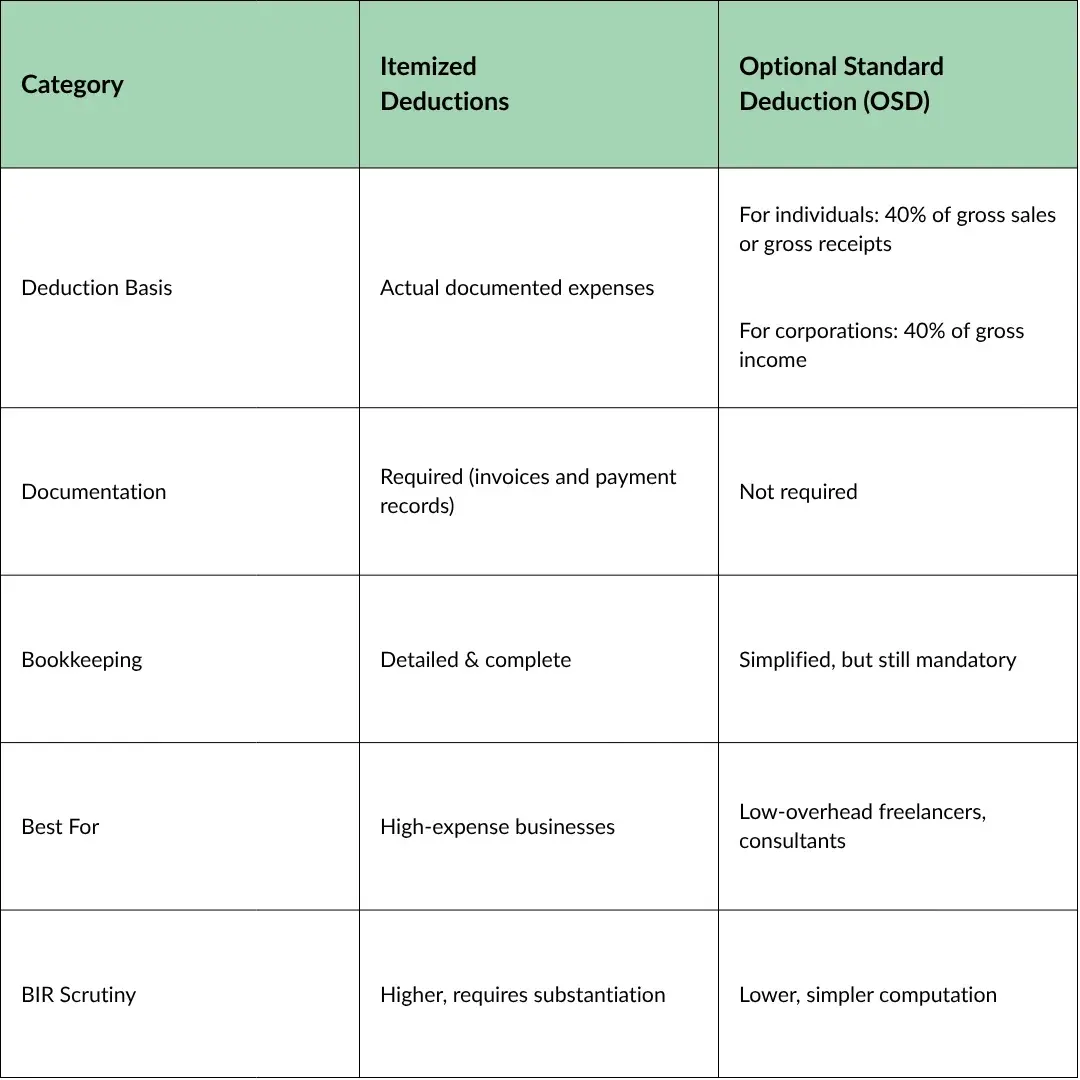
OSD vs. Itemized Deductions: Side-by-Side - Side-by-side comparison of Optional Standard Deduction (OSD) and itemized deductions in the Philippines, including their deduction basis, documentation requirements, bookkeeping obligations, and ideal use cases.
As clarified in this BIR-aligned commentary on OSD compliance, your choice applies for the entire taxable year and cannot be changed once elected on your tax return.
Real-Life Examples
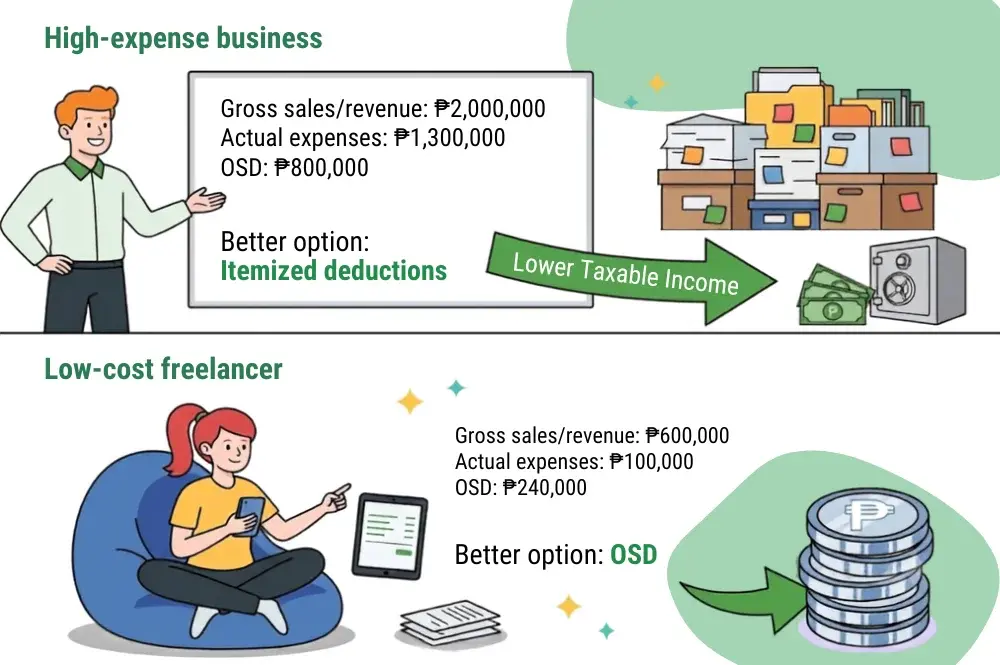
Real-Life Examples - Real-life examples comparing itemized deductions and the 40% Optional Standard Deduction (OSD) for a high-expense business and a low-cost freelancer.
Example 1: Business With High Expenses
Annual gross receipts: PHP 2,000,000
Actual expenses: PHP 1,300,000
Itemized Deduction: PHP 1,300,000
OSD (40%): PHP 800,000
Itemized provides a higher deduction.
Freelancer With Low Costs
Annual gross receipts: PHP 600,000
Actual expenses: PHP 100,000
Itemized Deduction: PHP 100,000
OSD (40%): PHP 240,000
OSD results in a better deduction and faster filing.
When and How to Choose Your Deduction Method
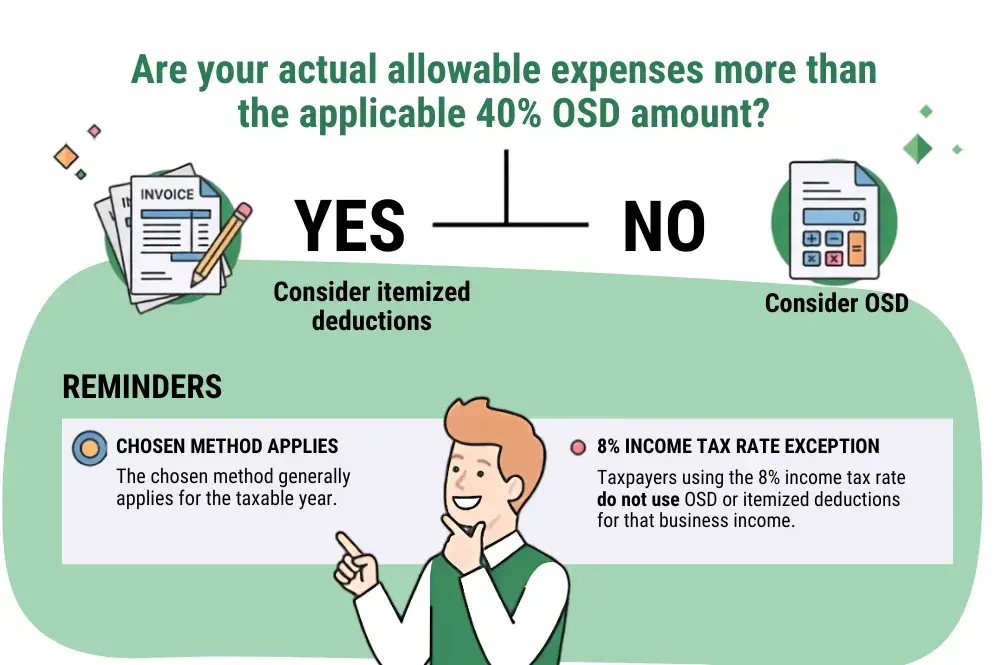
When and How to Choose Your Deduction Method - Guide to choosing between OSD and itemized deductions based on actual allowable expenses, with reminders about the taxable-year election and 8% income tax rate exception.
You must elect your preferred deduction method when filing your first quarterly income tax return for the taxable year. Once elected, the same method must generally be used consistently for the rest of the taxable year.
Eligible taxpayers may choose either of the following:
Itemized Deductions – based on actual allowable and properly substantiated expenses
OSD – a standard deduction equal to 40% of the applicable tax base
Important note: Individuals who choose the 8% income tax rate do not use OSD or itemized deductions for that business income. OSD applies under the regular income tax regime.
Once filed, your choice is irrevocable for the taxable year. If you don’t declare OSD explicitly, you are assumed to use itemized deductions.
Tax Filing Tips for 2026
Run a side-by-side computation
Compare both methods before you file to see which reduces your tax bill.
Maintain records regardless of choice
Even under OSD, invoices and sales records should be properly organized and recorded.
Stay updated on BIR forms
Always check for updates on official BIR forms and filing deadlines.
Plan annually
Your deduction method can be re-evaluated every tax year depending on how your expenses change.
Related Reading: To discover more expert advice to help you stay compliant and save on taxes year-round, explore our tax guides and resources.
Choose Smarter to Pay Less Tax
Making the right choice between Optional Standard Deduction and Itemized Deductions isn’t just about simplifying your tax return — it’s about keeping more of what you earn. Your decision should be guided by real numbers, not assumptions.
If your expenses are consistently high and well-documented, itemizing gives you a better tax position.
If you prefer simplicity and have minimal costs, OSD is the faster, easier, and often smarter route.
Both methods are legitimate — but only one will truly serve your current income structure. As tax laws evolve and your business grows, revisit this choice every year to make sure it still fits.
Need Help Navigating Tax Choices?

Need Help Navigating Tax Choices? - Accountable PH provides professional guidance to help taxpayers compare deduction methods, review their records, and choose a compliant tax strategy.
Whether you’re a first-time filer or a growing business, our team at Accountable PH can guide you through the numbers and help you choose the right strategy for compliance and savings.
Let’s make your tax season stress-free and smarter.
Book a Consultation Today!
Tags:
BIR Compliance, Business Expenses, Corporations,, Freelancers, Income Tax, Itemized Deductions, Optional Standard Deduction, Philippine Tax, Sole Proprietors, Tax Planning
2024
2025
2026
August
July