tax
BIR Form 1701Q Q3 2026: Deadline, Computation, and Filing Guide
Posted by Mariel Therese Deocampo
onSeptember 27, 2026
If you are self-employed, a freelancer, a professional in private practice, or a sole proprietor in the Philippines, the end of September means another important tax period is closing.
The third quarter of 2026 ends on September 30, and qualified individual taxpayers must file BIR Form 1701Q, or the Quarterly Income Tax Return for Individuals, Estates and Trusts.
The Q3 income tax filing deadline may still seem far away, but it is better to start preparing early. Waiting until the due date to organize your Q3 transactions, collect your BIR Form 2307 certificates, and verify the figures carried forward from your Q1 and Q2 returns can turn a straightforward filing into a rushed one.
Here is what you should know before filing your Q3 return.
BIR Form 1701Q Q3 2026 at a Glance
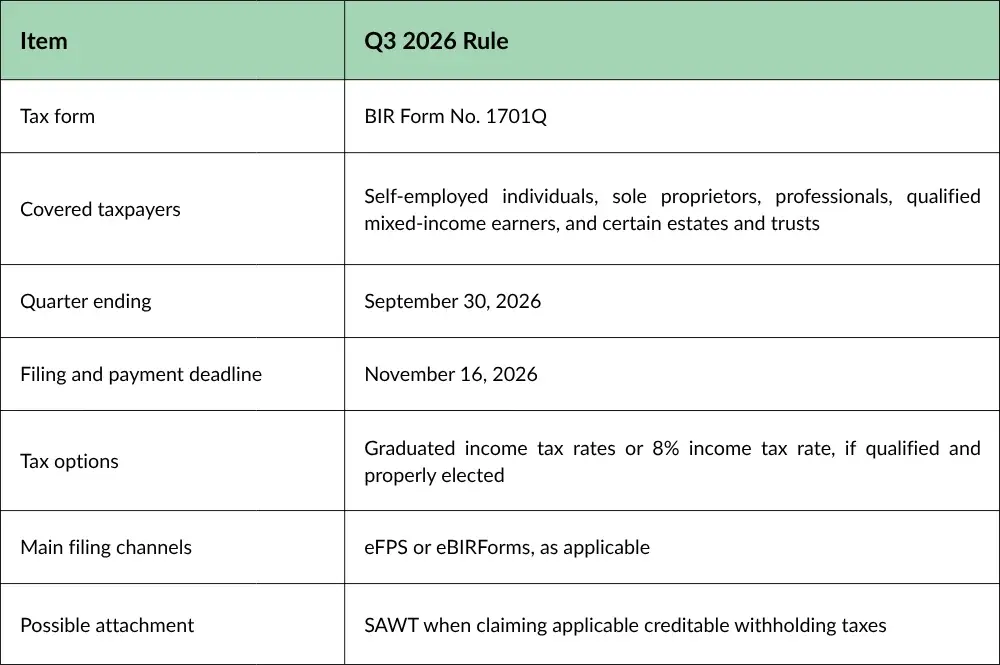
BIR Form 1701Q Q3 2026 Filing Overview - BIR Form 1701Q Q3 2026 overview showing covered taxpayers, the November 16, 2026 filing deadline, tax options, filing channels, and possible SAWT requirements.
BIR Form 1701Q is filed for the first, second, and third quarters of the taxable year. The taxpayer's total annual income and tax payments are then reported and reconciled in the applicable annual income tax return, which determines the taxpayer's final income tax liability.
What Is BIR Form 1701Q?
BIR Form 1701Q is the quarterly income tax return used by individuals earning income from business or the practice of a profession, as well as certain estates and trusts.
The return is used to report income and determine the taxpayer's income tax due for the quarter, taking into account taxable income from previous quarters and applicable tax credits or payments. The computation is based on the taxpayer's cumulative taxable income for the year to date.
If you are still in the registration stage, our guide to how self-employed individuals should register with the BIR explains when registration is required and what comes after registration.
Who Needs to File BIR Form 1701Q?
BIR Form 1701Q is filed by the following taxpayers, regardless of the amount of gross income:
Resident citizens engaged in trade, business, or the practice of a profession within and outside the Philippines;
Resident aliens, non-resident citizens, and non-resident aliens engaged in trade, business, or the practice of a profession within the Philippines; and
Trustees, guardians of minors, executors or administrators of estates, and other persons acting in a fiduciary capacity for a trust, estate, minor, or other person engaged in trade or business.
What About Mixed-Income Earners?
A taxpayer who earns both compensation income and income from a business or profession is considered a mixed-income earner.
For quarterly income tax filing, the taxpayer's business or professional income is reported in BIR Form 1701Q, but not compensation income. Instead, the employer reports the employee's compensation and applicable withholding tax through BIR Form 1601-C for monthly withholding tax reporting and BIR Form 1604C for annual information reporting. The taxpayer accounts for the compensation income and related tax withheld in the annual income tax return, together with the business or professional income.
This makes the distinction clear:
Business/professional income → reported by the taxpayer in Form 1701Q
Compensation income → reported by the employer through the required withholding/reporting; accounted for by the taxpayer in the annual return, when applicable.
Who Does Not Need to File Form 1701Q?
Employees who earn purely compensation income do not file BIR Form 1701Q because they do not have income from a trade, business, or practice of a profession. Depending on their circumstances, their compensation income may be covered by substituted filing or reported in an annual income tax return.
Likewise, taxpayers whose income consists solely of income subject to final withholding tax, or who are exempt from income tax under the Tax Code or other applicable laws, generally do not file an income tax return on the basis of that income.
What Is the Q3 1701Q Deadline for 2026?
Regular deadline for quarterly income tax returns is as follows:
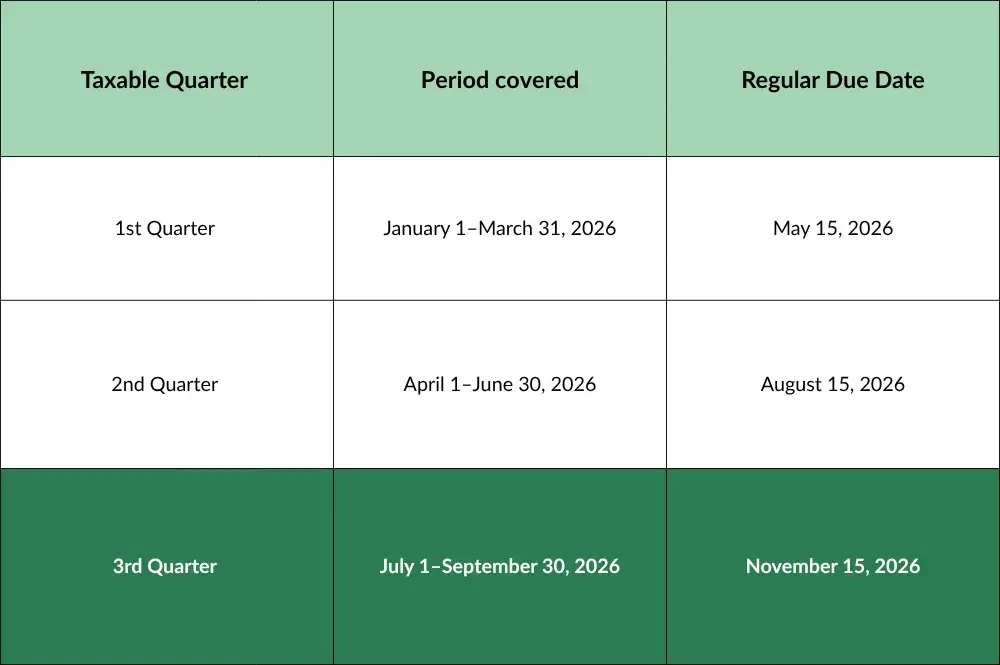
BIR Form 1701Q Q3 2026 Filing Deadline - Regular BIR Form 1701Q quarterly due dates for 2026. The Q3 regular due date is November 15, but since it falls on a Sunday in 2026, the filing and payment deadline moves to November 16, 2026.
Under the BIR's prescribed filing schedule, BIR Form 1701Q is due on November 15 following the close of the third quarter, as reflected in the BIR 2026 Tax Calendar. For 2026, however, November 15 falls on a Sunday. The deadline therefore falls on the next working day, Monday, November 16, 2026.
Taxpayers should still monitor future BIR advisories in case the Bureau announces any deadline changes.
Is Q3 1701Q Based Only on July to September Income?
Not exactly.
Although the third-quarter return covers the period from July 1 to September 30, 2026, the income tax computation in BIR Form 1701Q is cumulative for the taxable year.
The form takes into account the taxpayer's year-to-date taxable income, including amounts from previous quarters. It also considers applicable tax payments and creditable withholding taxes from earlier quarters when determining the amount of income tax still payable.
This means your Q3 return should not be treated as a standalone calculation based only on July through September transactions. The figures reported should be consistent with your cumulative records from January through September 2026.
This is why discrepancies in earlier quarters can create problems later. If your books and previously filed returns no longer agree, review Accountable PH’s guide on what happens if your books don't match your filed tax return before simply carrying the numbers forward.
How Is BIR Quarterly Income Tax Computed?
The computation of your quarterly income tax depends on the income tax rate you elected for the taxable year. For eligible individual taxpayers, there are two main options:
1. Graduated Income Tax Rates
Under the graduated income tax rates, the tax is based on your cumulative taxable income after deducting allowable deductions.
Depending on your chosen method of deduction, you may claim either:
Itemized deductions – based on actual allowable and properly substantiated expenses; or
Optional Standard Deduction (OSD) – 40% of gross sales or gross receipts for individual taxpayers.
For a detailed comparison of OSD and itemized deductions, see our guide: OSD vs. Itemized Deductions: Which One Saves You More
For the Q3 return, the taxable income for the current quarter is combined with taxable income from the previous quarters to arrive at cumulative taxable income to date. The applicable graduated tax rate is then applied to the cumulative taxable income.
The resulting tax due is reduced by applicable tax payments and credits, including income tax payments from previous quarters and creditable withholding tax supported by BIR Form 2307.
For taxable years beginning January 1, 2023 and onwards, the individual income tax rates are:
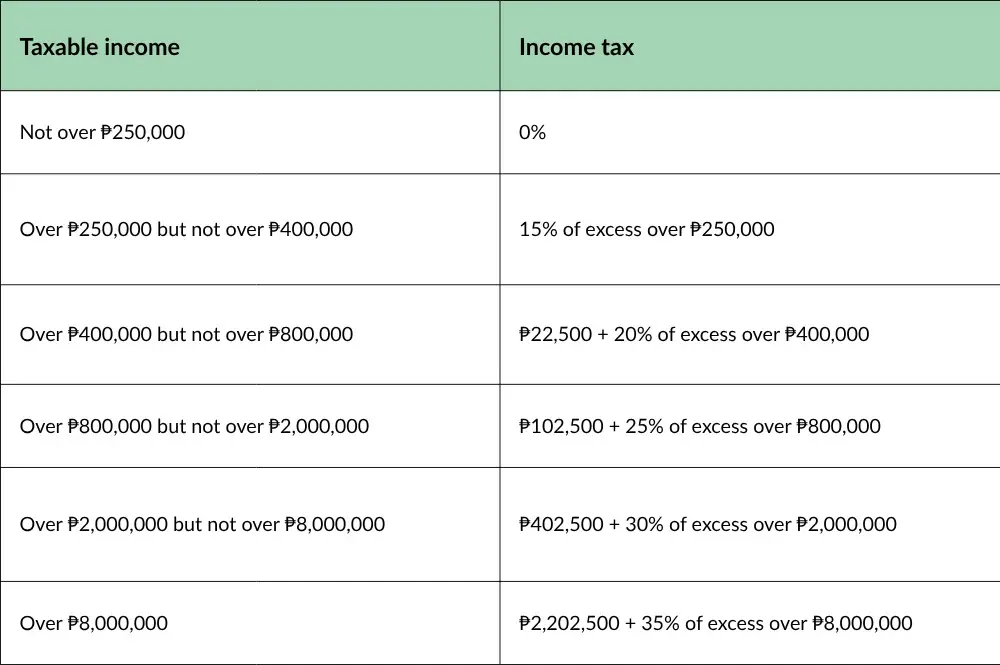
BIR Form 1701Q Q3 2026 Graduated Income Tax Computation - How BIR Form 1701Q is computed under graduated income tax rates, including cumulative taxable income, allowable deductions, prior-quarter tax payments, and the individual income tax rates effective from 2023 onward.
2. 8% Income Tax Rate
Eligible individual taxpayers who validly elected the 8% income tax rate compute their income tax based on gross sales or gross receipts and other non-operating income, rather than net taxable income after business expense deductions.
For a taxpayer earning income purely from business or the practice of a profession, the ₱250,000 reduction is applied to the cumulative gross sales or gross receipts and other non-operating income before applying the 8% rate.
However, the ₱250,000 reduction does not apply to the business or professional income of a mixed-income earner. A mixed-income earner is an individual who earns both compensation income and income from business or the practice of a profession. The ₱250,000 amount is already considered in the computation of the graduated income tax on the compensation and business/professional income, subject to the applicable rules.
Not sure which income tax rate to use or whether you are eligible for the 8% option? See our guide, Graduated Income Tax or 8% Special Tax Rate: Which is Better?
Important: You Cannot Simply Switch to 8% in Q3
This is an easy mistake to make.
Being eligible for the 8% income tax rate does not mean that a taxpayer can wait until the third quarter and choose the 8% option after seeing which calculation produces a lower tax.
The taxpayer must properly elect the 8% income tax rate within the period prescribed by the BIR. For existing taxpayers, the election is generally made when filing the first quarterly income tax return for the taxable year. Once validly elected, the chosen income tax rate generally applies for the taxable year.
When preparing the Q3 return, therefore, first confirm which income tax rate was elected earlier in the year. Do not switch between the graduated income tax rates and the 8% income tax rate simply because one produces a lower Q3 or year-to-date tax calculation.
How Does BIR Form 2307 Affect Your 1701Q?
If a client or customer withheld creditable income tax from payments made to you, you should receive a BIR Form 2307 (Certificate of Creditable Tax Withheld at Source).
The amount shown on Form 2307 is not an additional tax on top of your income tax liability. It represents income tax already withheld and remitted to the BIR on your behalf and may be claimed as a credit against your income tax due, subject to the applicable rules and supporting documentation.
This is particularly important when preparing your Q3 return because BIR Form 1701Q includes creditable withholding taxes from previous quarters as well as creditable tax withheld during the current quarter. Your Q3 computation should therefore include applicable withholding tax credits from January through September, not just those reflected on Q3 certificates.
When claiming creditable withholding taxes, the taxpayer should also prepare the Summary Alphalist of Withholding Taxes (SAWT) and submitted through [email protected]. BIR issuances provides guidelines for SAWT submission in connection with the relevant income tax return and supporting withholding tax credits.
Do not wait until filing day to ask clients for missing 2307s. Reconcile the certificates against your accounting records first so you do not accidentally claim an unsupported amount or fail to claim a valid tax credit.
A 2026 Update on the Term “Gross Receipts”
Taxpayers may notice that older BIR forms and regulations refer frequently to “gross sales or gross receipts.”
The Ease of Paying Taxes Act changed this treatment. Under Revenue Regulations No. 3-2024, BIR now uses gross sales for both sale of goods and services. The EOPT changes also shifted the recognition of service sales from a cash-based to an accrual-based approach for these tax purposes.
The EOPT reforms also introduced the Invoice as the principal sales document for both goods and services, replacing the previous distinction between sales invoices and official receipts for these purposes.
Because Form 1701Q was originally issued before those EOPT changes, some of its wording still reflects the older terminology.
What If You Have No Income or No Tax Due?
A zero tax payable does not automatically mean there is no filing obligation.
For example, your deductions and credits may reduce the amount payable to zero, or your business may have had little or no activity during the quarter. If you remain registered for and required to file Form 1701Q, you still need to submit the applicable return by the deadline.
The BIR's electronic-filing guidance expressly provides procedures for “No Payment” returns, including electronic submission through eBIRForms where applicable.
This distinction matters because filing the return and paying tax are separate compliance requirements.
Do You Also Need to File Percentage Tax for Q3?
It depends on your tax status and the income tax option you elected.
If You Use the Graduated Income Tax Rates
If you are a non-VAT taxpayer who is subject to the 3% percentage tax under Section 116 of the Tax Code, your percentage tax is separate from your income tax.
You may therefore need to file:
BIR Form 2551Q – for quarterly percentage tax; and
BIR Form 1701Q – for quarterly income tax.
These are two separate tax returns with different deadlines.
For Q3 2026, the period covered by Form 2551Q is July 1 to September 30, 2026. The regular deadline is October 25, but because October 25, 2026 falls on a Sunday, the deadline moves to Monday, October 26, 2026.
Your Q3 income tax return, on the other hand, is due later, on November 16, 2026.
If You Use the 8% Income Tax Rate
If you are eligible for and properly elected the 8% income tax rate, the 8% tax applies in lieu of the graduated income tax on your business or professional income and the 3% percentage tax under Section 116.
In that case, you generally do not file a separate Form 2551Q for percentage tax while you remain validly covered by the 8% option.
Common Q3 1701Q Mistakes to Avoid
Q3 filing mistakes are not always caused by the tax return itself. Many happen because the underlying records are incomplete, inconsistent, or not properly carried forward from earlier quarters.
Before filing your Q3 1701Q, watch out for these common mistakes:
Treating Q3 as a standalone calculation. The Q3 return is based on cumulative figures for the year, so your January–September records and previous quarterly returns need to agree.
Using the wrong income tax rate. You cannot simply switch between the graduated income tax rates and the 8% income tax rate in Q3 based on which produces a lower tax. Check which option was properly elected earlier in the year.
Applying the ₱250,000 reduction to a mixed-income earner's 8% tax base. The ₱250,000 reduction does not apply to the business or professional income of a mixed-income earner.
Failing to account for previous tax payments. Make sure income tax payments and other applicable credits from Q1 and Q2 are properly reflected in the cumulative Q3 computation.
Claiming incorrect Form 2307 amounts. Reconcile your creditable withholding tax claims with the actual BIR Form 2307 certificates you received. Do not claim amounts that cannot be supported by the certificates and your records.
Forgetting the SAWT. If you are claiming creditable withholding tax, make sure the required Summary Alphalist of Withholding Taxes (SAWT) is prepared and submitted through the prescribed BIR channel.
Waiting until the deadline to reconcile your books. By Q3, you are dealing with nine months of transactions. Reviewing your records only when the return is due can make it harder to identify and correct discrepancies.
If your records need to be corrected before filing, Accountable PH’s Accounting & Bookkeeping services cover transaction recording, bank reconciliation, catch-up bookkeeping, financial statements, and tax preparation and filing.
What Happens If You File 1701Q Late?
Late filing or payment can result in surcharges, interest, and applicable compromise penalties.
The Ease of Paying Taxes Act introduced special concessions for taxpayers classified as Micro and Small, including a reduced civil penalty rate of 10% under Section 248 and a 50% reduction in the applicable interest under Section 249, subject to the law and implementing rules.
However, the best strategy is still to file accurately and on time rather than rely on reduced penalties after the deadline.
There Is No Fourth-Quarter BIR Form 1701Q
One important thing to remember: BIR Form 1701Q is filed only for the first three quarters of the year.
There is no separate Q4 Form 1701Q. Instead, income and expenses from October through December are included in the taxpayer's annual income tax return, which reconciles the full year's income, allowable deductions, tax payments, and applicable tax credits.
For a broader overview of annual income tax filing, see the ITR guide for the Philippines.
Do Not Wait Until November to Check Your Q3 Books
The November 16 filing date may make Q3 income tax feel like a November task.
It is not.
The numbers you eventually report on Form 1701Q come from the records you build throughout the quarter. Missing invoices, unreconciled bank transactions, incorrect expense entries, missing BIR Form 2307 certificates, and differences between your books and previously filed returns are easier to resolve before the filing deadline gets close.
By the time Q3 ends on September 30, your goal should be to have your books substantially updated and know what documents are still missing.
That gives you time to fix the records instead of fixing the return after it has already been filed.
Need Help Preparing for Your Q3 1701Q Filing?

Q3 1701Q Filing Help | Accountable PH - Need help preparing for your Q3 1701Q filing? Accountable PH provides accounting, bookkeeping, reconciliation, and tax preparation support for businesses, freelancers, and professionals in Cebu and Manila.
Accurate tax filing starts with accurate books.
Accountable PH provides accounting and bookkeeping support for businesses, freelancers, and professionals in Cebu and Manila. Services include transaction recording, reconciliation, catch-up bookkeeping, financial statement preparation, and tax preparation and filing.
For Manila clients, tax-related support is provided in connection with the bookkeeping package.
If your books are behind or you're unsure whether your Q3 records are ready, it is better to review them before the November deadline.
Book a consultation today.
Frequently Asked Questions
When is the Q3 1701Q deadline in 2026?
The regular Q3 deadline is November 15. Because November 15, 2026 falls on a Sunday, the 2026 filing and payment date is November 16, 2026.
Do freelancers need to file BIR Form 1701Q?
A freelancer registered as a self-employed individual or professional files quarterly income tax returns when required under their BIR registration and applicable tax rules. The obligation is not limited to formally licensed professions.
Do I need to file 1701Q if I earned nothing during the quarter?
Having no tax payable does not by itself remove an existing filing obligation. If you are required to file Form 1701Q, a no-payment return may still need to be submitted electronically.
Do I include my salary in BIR Form 1701Q if I am a mixed-income earner?
No. The BIR's instructions state that compensation income need not be reported in the quarterly income tax return. It is reported through the annual income tax return. Your business or professional income is the portion relevant to 1701Q.
Can I deduct ₱250,000 under the 8% rate?
A purely self-employed individual or professional using the qualified 8% option gets the ₱250,000 reduction. A mixed-income earner does not deduct the ₱250,000 from the business income subject to the 8% option.
Can I choose the 8% tax rate when I file Q3?
Generally, no. The 8% income tax rate must be properly elected within the applicable period, generally when filing the first quarterly income tax return for the year. You cannot switch to 8% in Q3 simply because it results in a lower tax.
Can BIR Form 2307 lower my Q3 tax payable?
Yes, valid creditable withholding tax supported by Form 2307 may be credited against income tax due, subject to the applicable BIR requirements. Form 1701Q contains specific fields for those credits.
Is there a Q4 Form 1701Q?
No. Form 1701Q covers only the first, second and third quarters. Fourth-quarter activity is reconciled through the applicable annual income tax return.
Tags:
8% Income Tax, Bir, BIR Form 1701Q, Freelancer Tax, Income Tax, Quarterly Income Tax, Self-Employed, Tax Compliance
2024
2025
2026