tax
BIR Tax Abatement 2026 for Micro Taxpayers in the Philippines
Posted by Mariel Therese Deocampo
onJuly 14, 2026
A missed tax return from a few years ago. A BIR penalty you kept postponing. A business you stopped operating but never formally closed.
These problems do not simply disappear with time. They can remain in your BIR records, accumulate penalties, and resurface when you apply for tax clearance, update your registration, close your business, or process another government requirement.
Here’s where RR No. 4-2026 may help.
The Bureau of Internal Revenue has introduced a limited opportunity for qualified micro taxpayers to resolve certain old tax liabilities and open cases.
Under Revenue Regulations No. 4-2026, qualified micro taxpayers may apply for a one-time abatement of certain taxes and penalties, including surcharge and interest. The program covers eligible cases existing as of December 31, 2025, and remains available until December 31, 2026, unless the government extends it.
But before you assume that paying ₱5,000 will automatically clear every BIR problem, take a closer look. The program has specific eligibility rules, limits, filing procedures, and deadlines.
What Is the BIR One-Time Tax Abatement Program?
The BIR tax abatement program gives qualified micro taxpayers a chance to settle certain delinquent accounts, tax assessments, and open stop-filer cases.
It may also cover taxpayers who already stopped operating but still have unresolved BIR obligations.
The regulation calls this an abatement, not a general tax amnesty. It does not automatically erase every tax liability. The BIR will review whether the taxpayer and the case meet the requirements under RR No. 4-2026.
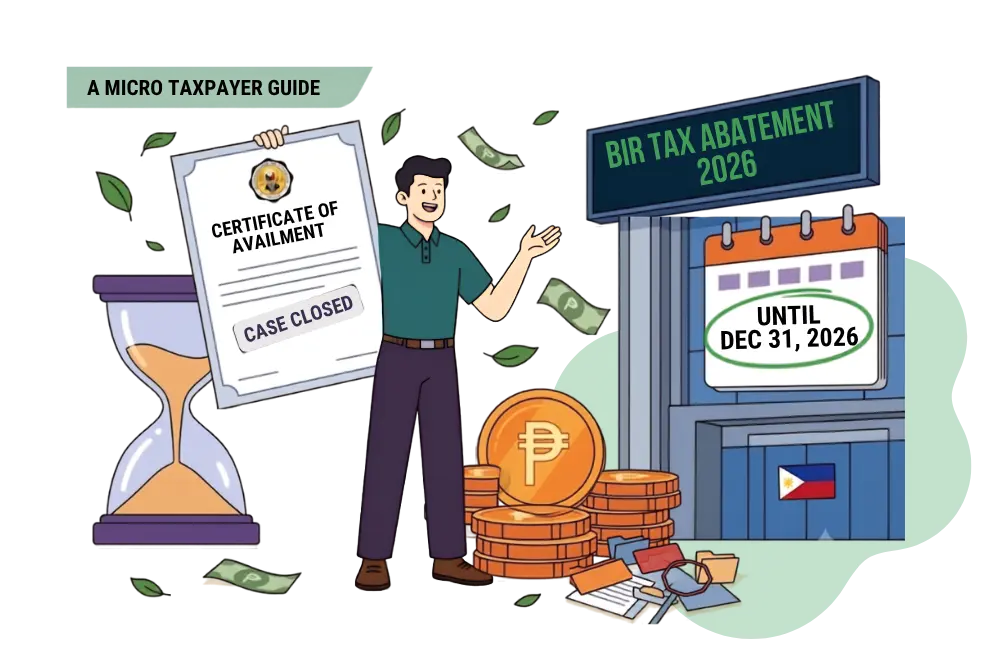
For approved applications, the taxpayer pays a ₱5,000 abatement fee. The concerned Revenue District Office then issues a Certificate of Availment after receiving and verifying the proof of payment. The certificate confirms the taxpayer’s availment and the closure of the case covered by the approved application.
When Does RR No. 4-2026 Take Effect?
RR No. 4-2026 takes effect 15 days after its publication in the Official Gazette or on the BIR website, whichever comes first. The BIR published the regulation on its website on June 22, 2026.
Qualified taxpayers may apply until December 31, 2026, unless the Secretary of Finance extends the period upon the recommendation of the Commissioner of Internal Revenue.
That may sound like plenty of time, but taxpayers with several years of missing returns or incomplete records may need weeks to identify and reconcile their cases. Waiting until December could make the process harder than it needs to be.
Who Qualifies as a Micro Taxpayer?
A micro taxpayer is a taxpayer whose gross sales for the taxable year fall below ₱3 million.
This classification can apply to both individuals and juridical entities, including:
Sole proprietors
Freelancers
Self-employed professionals
Partnerships
Corporations
Other registered business entities
For mixed-income earners, the BIR only considers business income when determining the taxpayer classification. Compensation earned through an employer-employee relationship does not form part of the gross sales calculation for this purpose.
The ₱3 million classification comes from the taxpayer categories introduced under the Ease of Paying Taxes Act and its implementing regulations.
What Tax Cases Can Qualify?
RR No. 4-2026 applies to covered cases existing as of December 31, 2025.
These include the following:
Delinquent tax accounts
A delinquent account may arise when a taxpayer fails to pay a self-assessed tax on time or when a deficiency assessment becomes final and executory but remains unpaid.
For example, you may have filed a tax return showing an amount due but failed to complete the payment.
Preliminary or final tax assessments
The program may cover assessments that were preliminary or final, disputed or undisputed, as of December 31, 2025.
This may include cases involving a Preliminary Assessment Notice, Final Assessment Notice, or Final Decision on Disputed Assessment, subject to the conditions in the regulation.
Open stop-filer cases
A stop-filer case usually appears when a registered taxpayer fails to file a required tax return or submit required tax information on time.
This can happen even when the business had no sales or operations during the period. As long as the tax type remained active in the BIR registration, the taxpayer may still have had a filing obligation.
The program also covers eligible stop-filer cases involving micro taxpayers who already stopped operating.
Our guide to filing an Income Tax Return in the Philippines explains who needs to file, what documents to prepare, and what can happen when a deadline is missed.
Pending administrative protests and disputes
The regulation may cover cases with administrative protests pending before a Revenue District Office, Regional Office, Legal Service, Appellate Division, Collection Service, Enforcement Service, or another BIR National Office unit.
Certain cases pending before government offices or courts
Certain tax disputes before the Department of Justice or the courts may qualify when the cases have not yet become final and executory.
Tax collection cases filed in court may also fall within the coverage, subject to the conditions and exclusions under the regulation.
Certain criminal violations
The program may also cover certain criminal tax violations that have not yet been filed in court.
Cases already filed in court, including cases under the Run After Tax Evaders program and other tax fraud cases, generally do not qualify unless the Commissioner of Internal Revenue or an authorized representative allows availment on meritorious grounds.
Pending compromise or abatement requests
A taxpayer may apply even when a request for compromise settlement or a previous abatement request remains under evaluation.
BIR liabilities recorded in the taxpayer’s books
The program may cover amounts recorded or acknowledged in the taxpayer’s books as “Accounts Payable to BIR” or “Due to BIR.”
Cases involving penalties only
A taxpayer may still qualify even when there is no basic tax due, provided the penalties fall within the program’s threshold and the case meets the other requirements.
What Is the ₱80,000 Limit?
A taxpayer’s delinquent or assessed basic tax, penalties, or both must not exceed ₱80,000 for a taxable year.
This is an important detail: the BIR does not simply apply the ₱80,000 limit to each individual notice or case.
The threshold refers to the total basic tax liabilities and penalties arising from covered violations for one taxable year.
For illustration, suppose a taxpayer has the following obligations for 2023:
₱30,000 in unpaid percentage tax
₱20,000 in penalties for missing income tax returns
₱15,000 in another covered BIR penalty
The total for 2023 would be ₱65,000, which falls within the ₱80,000 threshold.
If the total reaches ₱90,000, the covered cases for that taxable year would not meet the program’s ₱80,000 threshold.
This is why you need to identify all open cases for the year before filing. Looking at only one notice could give you the wrong impression about your eligibility.
Not sure whether your open BIR cases fall within the ₱80,000 limit?
Accountable PH can help organize your tax records and review your liabilities by taxable year before you file an application.
Book a Consultation Today!
Can a Closed or Inactive Business Apply?
Yes. A micro taxpayer who already ceased business operations may apply when the taxpayer still has qualifying delinquent accounts, assessments, or stop-filer cases.
Stopping operations, does not automatically close a BIR registration.
A taxpayer who stopped selling, serving clients, or operating a physical location may continue to accumulate filing obligations if the BIR registration remains active. The business must still complete the formal closure or cancellation process with the BIR.
The abatement program may help resolve eligible old cases, but it does not replace the formal business closure process.
How to Apply for the BIR Tax Abatement
The regulation requires taxpayers to file the application manually with the Revenue District Office that has jurisdiction over the taxpayer.
The process follows these main steps.
1. Review your BIR registration and open cases
Start by identifying your registered tax types and the returns you should have filed for each taxable year.
Check for:
Unfiled tax returns
Filed but unpaid returns
BIR notices or assessments
Stop-filer cases
Pending protests
Penalties recorded in your books
Obligations connected to a business that already stopped operating
Do not rely on memory alone. Compare your BIR registration, filed returns, payment records, books of accounts, and notices.
2. Determine whether you qualify as a micro taxpayer
Confirm that your gross sales for the relevant year fell below ₱3 million.
Mixed-income earners should use business income for the classification and exclude compensation earned as an employee.
3. Calculate the total covered amount per taxable year
Combine the basic tax liabilities and penalties for all covered cases within the same taxable year.
The total must not exceed ₱80,000.
You need to perform this review separately for every taxable year included in your application.
4. File a separate application for each taxable year
The taxpayer or an authorized representative must manually file the prescribed application form attached to RR No. 4-2026 as Annex A.
Each application must cover one taxable year.
The application must clearly state:
The applicable tax types
The basic tax amount due for each covered case
The taxable year involved
The basic amount stated in the application should exclude interest.
Failing to identify a tax type or basic amount due in a covered case may lead to the denial of the application.
5. Pay the ₱5,000 abatement fee
Once the RDO accepts the application, the taxpayer must pay the ₱5,000 abatement fee using BIR Form No. 0605.
The taxpayer may pay electronically or manually in accordance with the applicable BIR payment rules.
The payment must be completed within five working days from filing the application.
6. Submit proof of payment
After paying, submit the proof of payment to the concerned RDO within five working days from the payment date.
Missing this deadline automatically voids the application.
The taxpayer may refile, provided the availment period has not ended.
7. Wait for the Certificate of Availment
The RDO should issue the Certificate of Availment within five working days after receiving and verifying the proof of payment.
The certificate serves as proof that the taxpayer complied with the program and that the BIR closed the case covered by the approved application.
What Happens If the Application Is Denied or Withdrawn?
The ₱5,000 fee is not refundable when the taxpayer withdraws the application or when the BIR denies it.
Instead, the BIR will apply the payment as partial payment toward the taxes or penalties that the taxpayer wanted to have abated.
The same non-refund rule applies to payments that micro taxpayers made on covered cases before the regulation took effect. Taxpayers cannot recover those earlier payments through this program.
This makes an eligibility review important. Before paying, confirm that:
You meet the micro taxpayer classification
Your case falls within the program’s scope
The total amount stays within the ₱80,000 threshold
You identified all applicable tax types
You filed under the correct taxable year
Your supporting records match the figures in the application
Is the ₱5,000 Fee Paid Per Taxable Year?
RR No. 4-2026 requires taxpayers to file a separate application for each taxable year. The ₱5,000 fee becomes due once the RDO accepts an application. This indicates that each accepted application taxable-year requires its own ₱5,000 payment.
If you plan to file for several taxable years, confirm the payment instructions with your RDO before proceeding.
Why Your Books Matter Before You Apply
A tax abatement application is not only about filling out a form.
You need to know what appears in your books, what you reported in your tax returns, what you paid, and what the BIR still considers outstanding.
Problems often appear when:
Sales in the books do not match filed returns
Payments lack proper references or documentation
Expenses were recorded under the wrong period
Returns were filed but not reflected correctly
The business failed to record a BIR assessment
The taxpayer cannot identify which tax types remained active
A closed business continued to receive filing obligations
Clean records help you calculate the ₱80,000 threshold correctly and avoid leaving out a covered case from the application.
They also help you separate issues that the abatement may cover from obligations that still require another solution.
Incomplete books can make it harder to identify which taxable years and BIR cases need attention.
Accountable PH can help update, reconcile, and organize your financial records before you approach your RDO.
Get Bookkeeping Support.
Should You Apply Immediately?
Start reviewing your records now, but do not file blindly.
The program creates a valuable opportunity, especially for freelancers, small businesses, and former business owners who have avoided dealing with old BIR cases because the penalties felt overwhelming.
Still, the safest first step is to answer four questions:
Do you qualify as a micro taxpayer for the relevant year?
What open cases or assessments exist in your BIR records?
Does the total for each taxable year stay within ₱80,000?
Do your books and filed returns support the amounts in your application?
Once you know the answers, you can approach your RDO with a clearer and more complete application.
How Accountable PH Can Help
Not sure what cases remain open or whether your records match your filed returns?
Accountable PH can help you:
Review your books and prior tax filings
Identify missing or unrecorded transactions
Reconcile your books with your tax returns
Organize tax notices and payment records
Check for possible stop-filer periods
Calculate liabilities by taxable year
Prepare records for discussion with your RDO
Bring overdue bookkeeping up to date
We support businesses in Cebu and Manila. For Manila clients, bookkeeping is our core service, while tax-related assistance is available as an add-on to a bookkeeping package.
Learn more about our accounting and bookkeeping services, or book a consultation with Accountable PH to have your records reviewed before the December 31, 2026 deadline.
Frequently Asked Questions
What is the BIR tax abatement program for 2026?
It is a one-time program under RR No. 4-2026 that allows qualified micro taxpayers to apply for the abatement of certain taxes and penalties involving covered cases existing as of December 31, 2025.
Who qualifies as a micro taxpayer?
A micro taxpayer has gross sales below ₱3 million for the taxable year. For mixed-income earners, the classification only considers business income and excludes compensation income.
How much is the abatement fee?
The required abatement fee is ₱5,000 for an accepted application. The taxpayer must pay it using BIR Form No. 0605 within five working days from filing.
What is the maximum tax liability allowed?
The total covered basic tax liabilities, penalties, or both must not exceed ₱80,000 for a taxable year.
Can freelancers apply?
Yes. A registered freelancer or self-employed professional may apply if classified as a micro taxpayer and the case meets the other requirements.
Can corporations apply?
Yes. The program covers natural and juridical persons, provided the entity qualifies as a micro taxpayer and meets the case and amount requirements.
Can a business that already closed apply?
A taxpayer who stopped operating may apply for qualifying open cases. However, the taxpayer must still complete the formal BIR business closure process when the registration remains active.
When is the deadline?
Qualified taxpayers may avail themselves of the program until December 31, 2026, unless the Secretary of Finance extends the deadline.
Will the BIR refund penalties I already paid?
No. Payments made before the regulation took effect are not refundable.
What happens if I miss the proof-of-payment deadline?
The BIR will automatically void the application. You may refile as long as you do so within the availment period.
This article provides general information based on RR No. 4-2026. Eligibility and processing may depend on the facts and records of each taxpayer. Confirm your case with your Revenue District Office or a qualified tax professional before filing.
Tags:
Bir, Bookkeeping, Micro Taxpayer, RR No. 4-2026, Tax Abatement, Tax Penalties
2024
2025
2026
August
July