payroll
Year-End Tax Annualization 2026: What Employers Need to Check Before December Payroll
Posted by Mariel Therese Deocampo
onNovember 25, 2026
December payroll is not just another payroll run.
Before the year ends, employers required to withhold tax on compensation should reconcile their employees' taxable compensation and withholding tax for the calendar year through the year-end adjustment, commonly referred to as tax annualization.
Under BIR rules, the annualized withholding tax method is used when computing the year-end adjustment in December or when an employee's employment ends before the close of the calendar year. The employer determines the employee's taxable compensation for the year, computes the annual income tax due, and compares it with the tax already withheld.
November is therefore a good time to start reviewing payroll data instead of waiting until the final December payroll.
For a broader overview of employer payroll obligations, see Accountable PH's Payroll in the Philippines: A Comprehensive Guide for Employers.
What Is Year-End Tax Annualization?
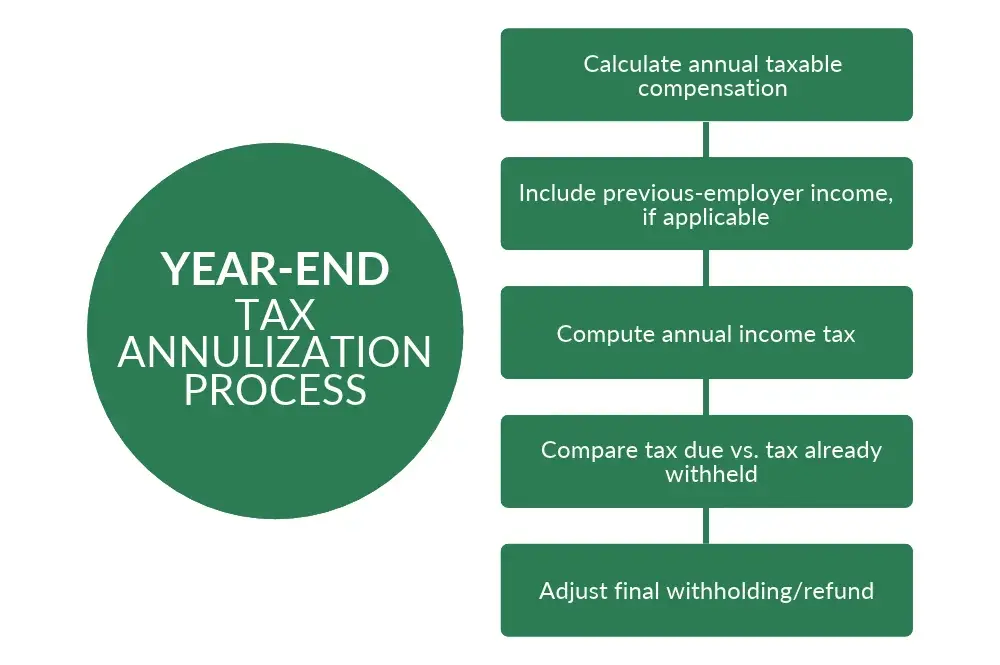
Year-end tax annualization is the process of reconciling an employee's total taxable compensation for the calendar year with the income tax already withheld from their salary and other taxable benefits. Its purpose is to ensure that the total tax withheld matches the employee's actual income tax due on their annual taxable compensation.
The BIR's annualized withholding tax method generally requires the employer to:
Determine the employee's taxable regular and supplementary compensation for the calendar year.
Include taxable compensation from a previous employer within the same year, when applicable.
Compute the annual income tax using the applicable tax rates.
Compare the tax due with the total tax already withheld and make the necessary year-end adjustment.
The individual income tax rates effective from 2023 onward remain applicable for 2026, ranging from 0% for taxable income not over ₱250,000 to 35% for taxable income over ₱8 million.
Employers can review the complete computation rules in the BIR's Revenue Regulations No. 11-2018.
What Should Employers Check Before Annualization?
Before processing the year-end adjustment, review the payroll information that affects each employee's taxable compensation and taxes already withheld.
Total compensation for 2026
Check regular salaries as well as taxable supplementary compensation such as applicable bonuses, commissions, overtime pay, allowances, and other compensation.
The goal is to make sure the payroll records reflect the correct amounts paid during the year before calculating the final annual tax.
Employees who changed employers during the year
This is especially important for employees hired midway through 2026.
If an employee had a previous employer during the same calendar year, the present employer performing the annualized computation must include the taxable compensation received from the previous employer. BIR Form 2316 from the previous employer provides the compensation and withholding information needed for this reconciliation.
Employers should therefore collect missing previous-employer BIR Form 2316s before year-end, not when December payroll is already being finalized.
13th-month pay and other benefits
Employers should also review the tax treatment of 13th-month pay and other benefits when computing an employee’s annual taxable compensation.
Under the TRAIN Law, 13th-month pay and other qualifying benefits are tax-exempt up to a combined limit of ₱90,000. This includes the 13th-month pay, Christmas bonuses, and other benefits covered by the law. Any excess over the ₱90,000 limit is subject to income tax.
Employers should therefore avoid automatically treating every bonus or year-end benefit as tax-free.
De minimis benefits and updated 2026 ceilings
Employers should also review the de minimis benefits provided to employees and check whether they meet the conditions and limits prescribed by the BIR.
BIR Revenue Regulations No. 29-2025 increased several ceilings for de minimis benefits. Amounts that meet the applicable requirements and stay within the prescribed ceilings are excluded from taxable compensation.
Some of the commonly encountered 2026 ceilings include:
| Benefit | 2026 non-taxable ceiling |
|---|---|
| Rice subsidy | ₱2,500 per month |
| Uniform and clothing allowance | ₱8,000 per year |
| Actual medical assistance | ₱12,000 per year |
| Laundry allowance | ₱400 per month |
| Christmas and major anniversary gifts | ₱6,000 per year |
| Employee achievement awards | ₱12,000 per year, subject to BIR conditions |
RR No. 29-2025 also covers other de minimis benefits, including medical cash allowance to dependents, monetized unused vacation leave, overtime/night-shift meal allowances, and certain CBA and productivity incentives.
Employers should use the updated limits when reviewing 2026 payroll instead of relying on older payroll references.
See the official BIR Revenue Regulations No. 29-2025 for the complete rules.
What happens when a de minimis benefit exceeds its ceiling?
Any amount exceeding the prescribed de minimis ceiling is no longer treated as a tax-exempt de minimis benefit. Instead, the excess is included in the employee's other benefits and counted toward the combined ₱90,000 tax-exempt limit for 13th-month pay and other qualifying benefits. Any amount exceeding the ₱90,000 limit is subject to income tax and withholding tax on compensation.
What Happens If Too Much or Too Little Tax Was Withheld?
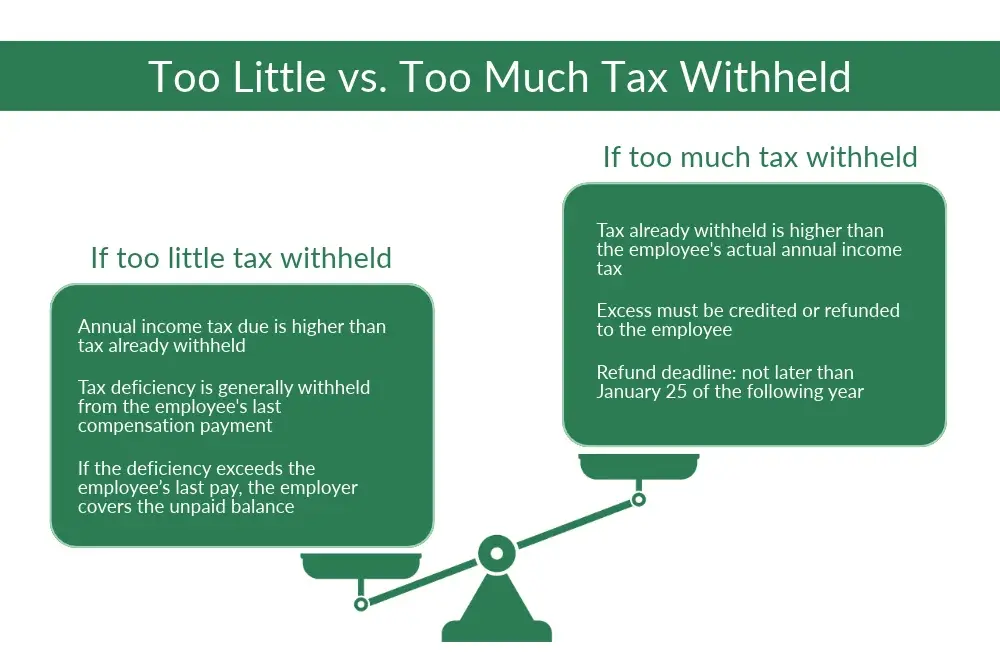
This is one of the main reasons year-end tax annualization is necessary. It determines whether the employee has an outstanding tax deficiency or has paid more tax than required through payroll withholding.
If too little tax was withheld
If the annual income tax due is higher than the tax already withheld during the year, the deficiency is withheld from the employee's last compensation payment for the calendar year.
If the tax deficiency exceeds the employee's last compensation payment, the employer is liable to pay the portion that cannot be withheld. Any obligation of the employee to reimburse the employer for this advance is a matter of settlement between them, as provided under RR No. 11-2018.
If too much tax was withheld
If the tax already withheld is higher than the employee's actual annual income tax, the excess must be credited or refunded to the employee.
Under RR No. 11-2018, the refund must be made not later than January 25 of the following year. For employees whose employment terminates before December, the excess is refunded upon payment of the employee's last compensation.
That is why waiting until the last minute to reconcile payroll can create avoidable problems for both the employer and employees.
What Happens After the Annualization?
The annualized figures feed directly into the employer's year-end tax reporting.
BIR Form 2316
Employers required to withhold tax on compensation must furnish employees with BIR Form 2316, Certificate of Compensation Payment/Tax Withheld.
Under current BIR rules, the form must be furnished to employees on or before January 31 of the succeeding calendar year, or on the day of the last compensation payment if employment ends before year-end.
BIR Form 1604-C and Alphalist
The annualized computation for each employee must also be reflected in the employer's Alphalist attached to BIR Form 1604-C, Annual Information Return of Income Taxes Withheld on Compensation.
BIR currently requires Form 1604-C to be filed on or before January 31 of the year following the calendar year in which the compensation was paid or accrued.
Year-End Payroll Checklist for Employers
Before December payroll, employers should ideally have already checked:
Employee compensation records from January onward
Bonuses, commissions, allowances, and other supplementary compensation
13th-month pay and other benefits
De minimis benefits and updated 2026 ceilings
Previous-employer BIR Form 2316 for employees hired during the year
Total withholding tax already deducted
Employee TINs and payroll information
Employees who resigned or transferred during 2026
Records needed for BIR Form 2316 and the annual Alphalist
Fixing missing or inconsistent payroll information in November is usually much easier than discovering it while preparing the final payroll of the year.
Common Year-End Annualization Mistakes
One common mistake is annualizing only the employee's current monthly salary instead of reviewing taxable compensation for the whole calendar year.
Employers should also watch for missing previous-employer information, incorrect classification of bonuses and allowances, outdated de minimis benefit limits, and differences between payroll records and the withholding tax already remitted.
Annualization should reconcile the year's numbers—not introduce new discrepancies into them.
Need Help Preparing Your 2026 Year-End Payroll?

Accountable PH provides payroll processing support for businesses in Cebu and Manila, including payroll calculation, deductions and withholdings, government contribution support, BIR Form 2316, Alphalist preparation, and year-end reporting.
For Manila clients, payroll support is provided in connection with a bookkeeping package.
Book a consultation today.
Frequently Asked Questions
When should employers perform tax annualization?
The BIR annualized withholding tax method is used for the year-end adjustment in December, or in the employee's last month of employment when employment terminates before year-end.
Does a new employee's previous salary affect annualization?
Yes. If the employee had another employer during the same calendar year, the present employer performing the annualized computation must consider the taxable compensation from the previous employment. The employee's previous BIR Form 2316 is important for this purpose.
Is all 13th-month pay tax-free?
Not automatically. Under the TRAIN Law, 13th-month pay and other qualifying benefits are tax-exempt up to a combined limit of ₱90,000 per year. Any excess over this limit is included in the employee's taxable compensation and subject to income tax.
De minimis benefits that meet the BIR's prescribed conditions and ceilings are treated separately. However, any excess over the applicable de minimis ceilings is counted toward the ₱90,000 limit.
What happens if an employee was overwithheld?
The excess withholding tax must be credited or refunded to the employee not later than January 25 of the following year, subject to the applicable BIR rules.
Tags:
BIR Form 2316, Employers, Payroll, Tax Annualization, Withholding tax, Year-End Payroll
2024
2025
2026
September
August
July